Ahlmann Hydraulic Breakers for Sale | Find the Perfect Match for Your Model
2026-10-27

Choosing the right hydraulic breaker for an SDLG excavator requires more than matching the attachment to the excavator’s operating weight. Hydraulic flow, operating pressure, tool diameter, mounting dimensions, and working conditions also determine whether a breaker is suitable for a particular machine.
For construction contractors, equipment dealers, rental companies, and attachment distributors, the right combination can expand an SDLG excavator’s capabilities in concrete demolition, road maintenance, trenching, quarrying, and mining. An incorrectly matched breaker, however, may reduce productivity, increase hydraulic system stress, and lead to unnecessary maintenance costs.
BEILITE provides hydraulic breaker models for excavators across a wide range of operating weight classes. This guide introduces the recommended matching options for selected SDLG excavator models, explains the specifications buyers should verify, and helps procurement teams evaluate a suitable hydraulic hammer before requesting a quotation.

The following SDLG excavator hydraulic breaker compatibility chart provides a preliminary reference for buyers comparing excavator models and BEILITE attachments.
The recommendations are based on the model and weight information supplied for this guide. Actual compatibility must be verified against the specific SDLG machine’s technical documentation and the current BEILITE hydraulic breaker specification chart.
| SDLG Excavator Model | Approx. Operating Weight | Suggested BEILITE Breaker | Breaker Carrier Weight Range | Tool Diameter |
| ER620H / E620H | 2.0–2.2 t | BLTB-45 / BLTB-45C | 0.8–1.5 t | 45 mm |
| ER626H / ER627H | 2.6–2.7 t | BLTB-53 | 1.5–3.5 t | 53 mm |
| ER636H | 3.74–3.95 t | BLTB-60 | 3.5–5.5 t | 60 mm |
| E655H / ER655H | Approx. 5.5 t | BLTB-60 / BLTB-70 | 3.5–5.5 t / 4.5–6.0 t | 60 / 70 mm |
| E660H | Approx. 6.0 t | BLTB-70 | 4.5–6.0 t | 70 mm |
| E675H / E680H / E680F / ER680H | Approx. 7.5–8.0 t | BLTB-75 / BLTB-85 | 6.8–8.5 t / 7.0–11.0 t | 75 / 85 mm |
| E690H | Approx. 9.0 t | BLTB-85 | 7.0–11.0 t | 85 mm |
| E6135F / E6135H | Approx. 13.5 t | BLTB-100 | 10.0–14.0 t | 100 mm |
| E6150H / E6155H / E7150H / EA7150H | Approx. 15.0 t | BLTB-125 / BLTB-135 | 14.0–18.0 t / 18.0–22.0 t | 125 / 135 mm |
| E6210 / E6210F / E6210H / E7220H | Approx. 21.0–21.5 t | BLTB-135 / BLTB-140 | 18.0–22.0 t / 20.0–24.0 t | 135 / 140 mm |
| E6225H | Approx. 22.1 t | BLTB-140 / BLTB-150 | 20.0–24.0 t / 24.0–27.0 t | 140 / 150 mm |
| E6255H | Approx. 25.8 t | BLTB-150 / BLTB-155 | 24.0–27.0 t / 27.0–33.0 t | 150 / 155 mm |
| E6300F | Approx. 29.3 t | BLTB-155 / BLTB-165 | 27.0–33.0 t / 36.0–45.0 t | 155 / 175 mm |
| E6395H / E6500F | Approx. 39.5–50.0 t | BLTB-175 / BLTB-185 | 45.0–55.0 t / 50.0–60.0 t | 175 / 185 mm |
| E6505H | Approx. 52.0 t | BLTB-195 / BLTB-200 | 55.0–65.0 t / 60.0–75.0 t | 195 / 200 mm |
| E6600FB | Approx. 60.0 t | BLTB-200 / BLTB-205 | 60.0–75.0 t / 65.0–75.0 t | 200 / 205 mm |
| E6870H | Approx. 70.0–80.0 t | BLTB-215 / BLTB-220 | 68.0–85.0 t / 75.0–100.0 t | 215 / 220 mm |
| E6900H | Approx. 90.0 t | BLTB-230 / BLTB-245 | 90.0–130.0 t / 90.0–160.0 t | 230 / 245 mm |
Important matching note: The table is intended for initial model screening, not as a confirmed fitment list for every SDLG excavator configuration. Some suggested breaker carrier weight ranges do not directly cover the listed excavator operating weight. In those cases, obtain confirmation from BEILITE before placing an order. The tool diameter alone does not establish compatibility.
Before you buy a hydraulic breaker for an SDLG excavator, check the machine’s operating weight, hydraulic system specifications, and intended application. These factors help narrow down the available BEILITE models.
Operating weight is an important starting point when selecting an excavator hydraulic breaker. A breaker designed for a small excavator may not provide the impact energy required for heavy concrete or rock, while an oversized attachment may place excessive stress on the carrier.
For example, an SDLG ER636H in the approximately 3.8-ton class can be considered for a BEILITE BLTB-60, subject to hydraulic and mounting compatibility. An SDLG E6210 in the approximately 21-ton class may be considered for the BLTB-135 or BLTB-140.
These recommendations are preliminary matching references rather than guaranteed fitments. Confirm the operating weight of the specific machine configuration, including any relevant attachment or counterweight differences, before choosing the breaker.
A hydraulic hammer for an SDLG excavator must operate within the carrier’s permitted hydraulic flow and pressure ranges. Even when two machines have similar operating weights, their auxiliary hydraulic systems may differ.
Before selecting a model, verify:
Do not increase the excavator’s relief valve setting simply to meet a breaker’s requirements. The carrier and attachment must operate within their respective manufacturer-approved limits.
The right hydraulic breaker depends on what the excavator will break. Concrete slabs, reinforced concrete, limestone, granite, and other hard rock materials require different working strategies and may place different demands on the attachment.
A contractor performing occasional trenching may prioritize attachment weight and maneuverability. A quarry operator may focus on impact energy, operating stability, wear-part life, and service access.
The correct selection balances carrier compatibility with the material’s hardness, the required production rate, and the expected duty cycle.
Recommended Reading: 14 Common Uses of Hydraulic Breakers
Compact SDLG excavators are commonly considered for utility work, landscaping, small-scale demolition, drainage projects, and trenching. For these applications, buyers should pay particular attention to attachment weight, hydraulic flow, and machine stability.
The preliminary matching options include:
When selecting a hydraulic breaker for a compact excavator, avoid choosing a larger model solely because it has a larger tool diameter. The attachment must remain within the carrier’s permitted operating limits.
For contractors working on concrete pavement, small foundations, and utility trenches, a correctly matched breaker can give an existing SDLG excavator additional capability without requiring a separate carrier machine.
Recommended Reading: Hydraulic Breaker Parts: The Ultimate Technical Guide
Medium excavators cover a wider range of demolition, road construction, foundation work, and quarry applications. Breaker selection should account for the required impact energy as well as the carrier’s hydraulic capacity and stability.
For the E6135F and E6135H, the BLTB-100 is a preliminary option for evaluation. For the E6210 series, the BLTB-135 and BLTB-140 are suggested candidates. The E6225H can be evaluated with the BLTB-140 or BLTB-150, while the E6300F can be assessed for compatibility with the BLTB-155.
For machines in this class, confirm the following before buying:
For equipment distributors, a verified matching chart can also support inventory planning. It helps identify which breaker models deserve further technical evaluation for the excavator models commonly sold in the target market.
Recommended Reading: Hydraulic Breaker Greasing: How Often Is Enough?
Heavy SDLG excavators may be used in demanding quarrying, mining, and large-scale material processing operations. These applications require particular attention to attachment weight, excavator stability, hydraulic performance, and continuous-duty requirements.
The preliminary model options in the supplied chart include:
Heavy-duty hydraulic breakers are not interchangeable simply because their tool diameters are close. Their operating weight, mounting structure, hydraulic demand, and impact characteristics can differ significantly.
For mining and quarrying buyers, the selection process should also consider rock hardness, production targets, working cycles, wear-part availability, and the maintenance resources available at the site.
A model matching chart helps narrow the choices, but a final compatibility check is necessary before purchasing an SDLG excavator hydraulic breaker.
Provide the complete model designation, including any suffixes. For example, an E680F and an E680H should not automatically be assumed to have identical attachment requirements.
If possible, supply the machine’s serial number, operating weight, and relevant technical documentation. This allows the supplier to review the correct configuration instead of relying on a general model name.
Compare the excavator’s auxiliary hydraulic specifications with the selected BEILITE breaker specifications.
For example, the supplied matching reference lists a hydraulic flow range of 30–60 L/min for the BLTB-60 and 120–180 L/min for the BLT-140. These figures should be checked against the current model specification chart and the actual carrier’s hydraulic system before use.
Also confirm the allowable return pressure and whether additional hydraulic components are required.
The tool diameter is useful for identifying a breaker size, but it is only one specification.
The mounting arrangement must match the excavator’s linkage or quick coupler. Confirm the pin diameter, pin-to-pin distance, mounting width, bracket design, and hose connections.
A supplier may be able to provide a suitable mounting bracket or an OEM attachment solution if the standard configuration does not match the carrier.
The breaker should suit the material, work cycle, and operating environment.
For concrete demolition, consider the concrete thickness, reinforcement, and access conditions. For quarrying, evaluate rock hardness and the required production rate. For trenching, consider working space and the need for controlled breaking.
An attachment that is suitable for intermittent demolition may not be the right choice for prolonged heavy-duty quarry work.
Before purchasing, send the supplier the excavator model, operating weight, hydraulic flow, operating pressure, intended application, and destination country.
Ask for confirmation of the recommended breaker model, mounting dimensions, hydraulic requirements, and included accessories. This step is especially important for imported equipment, used excavators, and special configurations.
Recommended Reading: How to Attach a Hydraulic Hammer to a Bobcat Excavator?
For buyers evaluating a hydraulic breaker manufacturer or supplier, the decision should extend beyond the initial purchase price. Manufacturing quality, model coverage, replacement parts, technical assistance, and long-term operating costs all influence the value of an attachment.
BEILITE Machinery Co., Ltd. has manufactured hydraulic breakers since 2002 and supplies attachments for construction, demolition, mining, quarrying, and other demanding applications.
Recommended Reading:Best Excavator Hydraulic Hammer Brands in the Global Market
BEILITE offers hydraulic breaker models for different excavator weight classes and working requirements. Buyers can compare models according to carrier weight range, tool diameter, hydraulic flow, operating pressure, and other technical specifications.
This range gives contractors and equipment distributors a starting point for evaluating attachments for compact, medium, and heavy SDLG excavators.
For equipment dealers, importers, and attachment distributors, OEM cooperation can be an important purchasing consideration.
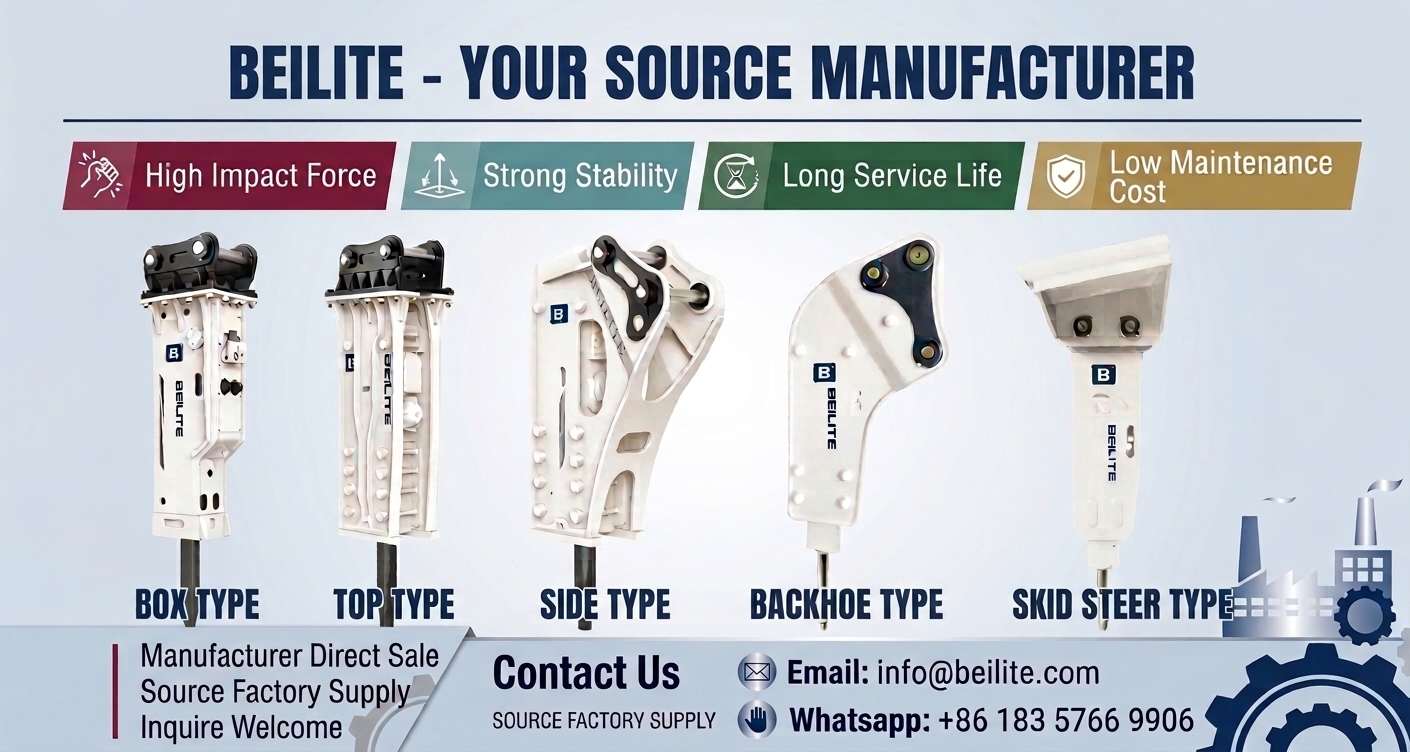
BEILITE can discuss OEM requirements, including applicable branding, product identification, packaging, and model selection, subject to project requirements and manufacturing confirmation. Beilite provide silenced hydraulic hammer, top-type hydraulic hammer, side-type hydraulic hammer and other types.
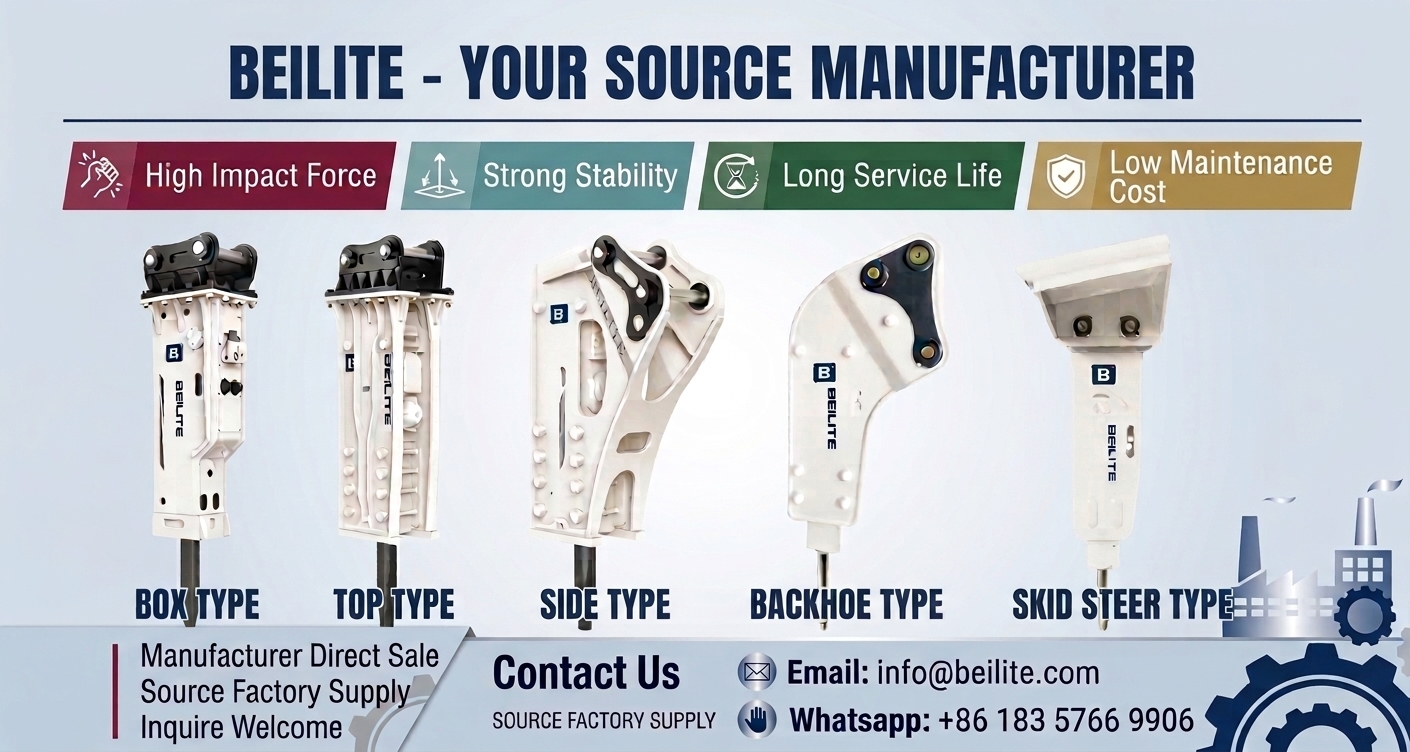
If you are sourcing a hydraulic breaker for an SDLG excavator, provide the carrier model and technical details so the BEILITE team can review the proposed configuration. A matching recommendation should be based on the actual machine and attachment specifications rather than the excavator brand alone.
A useful quotation should identify more than the breaker model and price. Buyers should also confirm the attachment’s specifications, mounting arrangement, included components, spare-parts requirements, and delivery terms.
For distributors purchasing multiple units, these details help establish a consistent product specification and reduce uncertainty when supplying attachments to end customers.
The hydraulic breaker price for an SDLG excavator depends on the breaker model, attachment size, technical configuration, and order requirements.
The main factors include:
When comparing hydraulic breakers for sale, buyers should compare equivalent configurations rather than choosing solely by the lowest quoted price. A quotation should clearly identify the breaker model, specifications, included accessories, delivery terms, and warranty conditions.
For an accurate BEILITE hydraulic breaker quotation, provide the excavator model, required quantity, application, destination country, and any OEM requirements.
The BLTB-60 is a preliminary candidate for the SDLG ER636H, whose operating weight is approximately 3.74–3.95 tons in the supplied reference. Confirm the machine’s hydraulic flow, operating pressure, mounting dimensions, and attachment capacity before ordering.
The supplied matching guide identifies the BEILITE BLTB-135 and BLTB-140 as preliminary options for the SDLG E6210 series. The final choice depends on the exact excavator configuration, hydraulic system, mounting arrangement, and intended application.
Not automatically. The excavator must have a suitable hydraulic circuit and sufficient attachment capacity. The breaker must also meet the carrier’s flow, pressure, return-line, and mounting requirements. Some machines may need additional piping, controls, or a compatible mounting bracket.
The required flow depends on the selected breaker model. For example, the supplied reference lists 30–60 L/min for the BLTB-60 and 120–180 L/min for the BLT-140. Check the current specification chart and confirm the carrier’s available flow before purchase.
The price varies with breaker size, technical configuration, mounting bracket, accessories, order quantity, OEM requirements, and delivery destination. Contact BEILITE with the excavator model and purchasing requirements to request a model recommendation and quotation.
BEILITE can discuss OEM and private-label requirements for suitable projects. Buyers should provide the required model range, branding specifications, order quantity, and destination so the manufacturer can confirm feasibility and commercial terms.
Provide the complete SDLG excavator model, operating weight, available hydraulic flow and pressure, required breaker application, destination country, and order quantity. If available, include mounting dimensions, machine technical documentation, or photographs of the existing attachment connection.
Choosing the right hydraulic breaker starts with identifying the excavator’s actual specifications and the demands of the job. The SDLG and BEILITE matching chart in this guide can help you shortlist potential models, but the final selection should be confirmed through a technical review.
Whether you operate a compact excavator for utility work, a medium machine for concrete demolition, or a heavy excavator for quarrying, BEILITE can help evaluate a suitable hydraulic breaker configuration based on your requirements.
Contact BEILITE to request a hydraulic breaker quotation and compatibility review.
Please provide:
With these details, the BEILITE team can review the appropriate breaker models, verify technical compatibility, and prepare a quotation for your project or distribution business.


 Phone/ Whatsapp: +86 40008-40008
 Email: info@beilite.com


