Ahlmann Hydraulic Breakers for Sale | Find the Perfect Match for Your Model
2026-10-27

Choosing a hydraulic hammer for a Terex machine requires more than matching the attachment to the equipment brand. Hydraulic flow, operating pressure, carrier weight, mounting dimensions, and the type of material being broken all affect compatibility and working performance.
For construction contractors, equipment rental companies, machinery dealers, and attachment distributors, the right hydraulic breaker expands the range of jobs a machine can handle. The wrong match, however, may lead to poor impact performance, excessive vibration, hydraulic overheating, or unnecessary maintenance costs.
This guide explains how to select a hydraulic hammer for Terex excavators and backhoe loaders, what specifications to check before purchasing, and how to compare suppliers when sourcing a replacement or additional attachment.
Terex has manufactured various types of construction equipment, including compact excavators, crawler excavators, and backhoe loaders. Hydraulic breaker compatibility depends on the specific machine configuration rather than the brand name alone.
Before selecting a breaker, identify the exact Terex model and confirm its hydraulic and mechanical requirements.
Compact excavators are commonly used for residential construction, landscaping, utility installation, trenching, and small demolition projects. A hydraulic hammer can help break concrete slabs, remove small rock formations, and prepare trenches where conventional bucket excavation is insufficient.
Historical Terex compact excavator models include:
These names are useful starting points when researching older Terex equipment. However, this list is not a automatic guarantee of fit for any particular breaker without checking parameters. Verify operating weight, auxiliary hydraulic flow, system pressure, and mounting dimensions before choosing an attachment.
Backhoe loaders are used for road maintenance, utility work, drainage construction, trenching, and general site preparation. A hydraulic breaker can replace the digging bucket when operators need to remove concrete, break pavement, or work on hard ground.
Terex backhoe loader models and model families have included the TX series and machines such as the 820, 860, 880, 970, and 980, depending on generation and market.
For these machines, buyers should confirm whether the breaker will be installed on the rear excavator arm, whether an auxiliary hydraulic circuit is available, and whether the machine’s mounting arrangement supports the proposed attachment.
To simplify your procurement process, the table below highlights popular Terex machines alongside their key hydraulic requirements and the recommended BEILITE (BLTB Series) hydraulic breakers:
| Terex Machine Model | Equipment Type | Machine Operating Weight | Auxiliary Hydraulic Flow | Operating Pressure | Recommended BEILITE Breaker Model PNG | Approved BEILITE Carrier Weight PNG | Chisel Diameter PNG | Impact Frequency PNG |
| Terex TC20 | Compact Excavator | ~2.0 t | 31.5 – 36 L/min | 180 bar | BLTB-45 / BLTB-45C | 0.8 – 1.5 t | 45 mm | 700 – 1200 bpm |
| Terex TC29 | Mini Excavator | ~2.9 t | ~58 L/min | 210 bar | BLTB-53 | 1.5 – 3.5 t | 53 mm | 600 – 1100 bpm |
| Terex TC35 | Mini Excavator | ~3.5 t | ~60 – 99 L/min | 250 bar | BLTB-60 | 3.0 – 5.5 t | 60 mm | 500 – 1000 bpm |
| Terex TC50 | Compact Excavator | ~5.0 t | ~70 – 100 L/min | 250 bar | BLTB-70 | 4.5 – 6.0 t / 5 – 6 t | 70 mm | 500 – 900 bpm |
| Terex TC75 | Mid-size Excavator | ~7.5 – 7.9 t | ~110 – 156 L/min | 280 bar | BLTB-85 | 6.0 – 8.5 t / 7 – 11 t | 85 mm | 400 – 800 bpm |
| Terex 820 / 860 / 880 / 970 | Backhoe Loader | ~7.0 – 8.5 t | ~100 – 150 L/min | 210 – 250 bar | BLTB-85 / BLTB-100 | 7 – 11 t / 10 – 14 t | 85 mm / 100 mm | 400 – 800 / 350 – 700 bpm |
Note: Terex specifications can vary by manufacturing year, region, and optional hydraulic packages. Always double-check your machine’s serial plate or manual before finalizing an order.
A suitable hydraulic hammer must work within the carrier’s mechanical and hydraulic limits. Buyers should evaluate the following factors before comparing prices.
The breaker’s weight affects machine stability, boom loading, and operational safety. An attachment that is too heavy reduces machine stability and places excessive stress on the boom and arm joints. Conversely, a breaker that is too small delivers insufficient impact energy and reduces productivity.
Use the machine manufacturer’s specifications and the breaker’s approved carrier-weight range as your primary guideline.
Hydraulic flow and pressure are critical technical parameters when purchasing a hydraulic hammer:
Before ordering, verify that your Terex machine’s auxiliary circuit specifications align with the breaker’s required range. Also verify relief valve settings and return-line backpressure limits.
Even when two machines share similar operating weights, their pin geometries can differ significantly. Check the following measurements before purchasing:
A custom mounting bracket or adapter top-plate can be engineered to ensure a plug-and-play fit.
| Application | Workpiece Characteristics | Key Breaker Selection Criteria |
| Concrete Demolition | Reinforced slabs, footings, curbs | High stroke rate, standard moil or wedge tool |
| Asphalt & Road Repair | Road surface removal, trench edges | Compact housing, chisel tool for clean cuts |
| Trenching & Utilities | Hard soil, shale, fractured rock | Narrow body profile for deep trench clearance |
| Quarrying & Hard Rock | Granite, basalt, limestone | Heavy-duty housing, larger chisel diameter, maximum impact power |
BEILITE provides three main structural housing designs for Terex carriers:
When evaluating quotations, focus on the total cost of ownership (TCO) rather than the initial purchase price alone.
To ensure a seamless fit for your Terex machine, provide your supplier with key machine specs when requesting a quote.
Terex Machine Model and Year of Manufacture
Machine Operating Weight (kg or lbs)
Auxiliary Hydraulic Flow Rate (L/min) and Working Pressure (bar)
Mounting Interface Details (Pin diameter, dipper width, or quick coupler model)
Target Application (Concrete demolition, trenching, rock breaking, etc.)
Destination Port / Country and Quantity required
Most Terex excavators can run a hydraulic breaker if equipped with an auxiliary hydraulic line and proper operating parameters. You must confirm that the breaker’s required hydraulic flow and pressure fall within your Terex machine’s output limits.
The BEILITE BLTB-53 is an excellent match for the Terex TC29 (~2.9t), while the BEILITE BLTB-60 matches the Terex TC35 (~3.5t). Both choices should be verified against your machine’s exact auxiliary flow and pressure ratings.
Yes. Terex backhoe loaders (such as the 820, 860, and 880 series) frequently run hydraulic breakers on their rear excavator arm for road patching and concrete removal. Models like the BEILITE BLTB-85 and BLTB-100 are popular fits for this tonnage class.
A complete BEILITE breaker kit typically includes:
Selecting the right hydraulic hammer expands your Terex equipment’s versatility and keeps job site production running smoothly.
Need help verifying hydraulic compatibility or bracket dimensions?
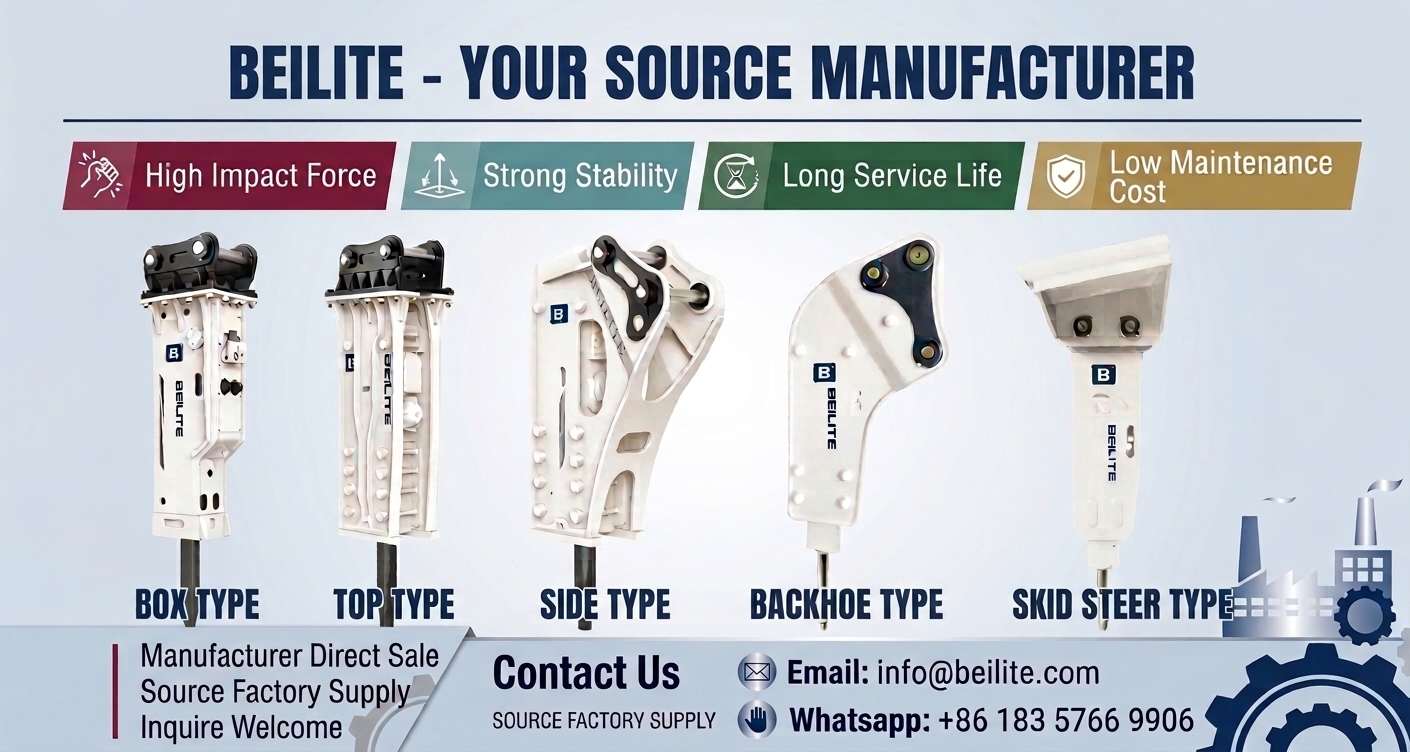
Contact BEILITE today with your Terex model and job requirements to receive a customized technical recommendation, bracket drawings, and a direct factory quotation!
Recommended Reading:
14 Common Uses of Hydraulic Breakers
Hydraulic Breaker Parts: The Ultimate Technical Guide
Hydraulic Breaker Greasing: How Often Is Enough?
How to Attach a Hydraulic Hammer to a Bobcat Excavator?
Best Excavator Hydraulic Hammer Brands in the Global Market
Buy Hydraulic Breaker for Terex Fuchs Excavator | Complete Guide




 Phone/ Whatsapp: +86 40008-40008
 Email: info@beilite.com


